Choosing the Right Pliers for the Job
Finding the correct pliers for the tasks at hand is a common occurrence on the job. To make the best decision, consider the pliers' overall arrangement and each element's unique design. With this knowledge, choosing an appropriate model is much easier. Each pair of pliers has at least three parts: the jaws, the joint, and the handle. The head includes both the jaws and the joint.The Jaws
The jaws might be designed to grasp, cut, or serve both roles. The jaw's shape is determined by its intended purpose. We differentiate between flat, flat-round, and round pliers. There are also particular shapes for specific uses, such as Long Reach Needle Nose Pliers, Electronics Mounting Pliers, and Mechanics Pliers. The selection is determined by the available working space and the application (gripping, holding, or bending).
Gripping Pliers
The jaws' gripping surfaces can be smooth, serrated, or cross-hatched, depending on the material to be processed and the pliers' intended use.
Cutting Pliers
Cutting pliers can be distinguished by the position and shape of the cutting edges. The cutting edge is positioned at a right angle, diagonally, or parallel to the handles, depending on the easiest way to reach the material to be cut.
End Cut
End cutters are utilized if the wire or materials can only be accessed from the tool's front. This can also be the situation when a wire needs to be cut flush with a surface. (With side cutters, the fingers that encircle the handles would get in the way here.)Oblique Cut
Oblique cutters are employed in situations when there is no front or side access to the material to be cut. Oblique cutters are arguably the least commonly utilized of the three types of cutters: front, side, and center.Diagonal Cut
Side cutters are the most common cutting pliers, available in a variety of lengths and materials. Examples include side cutters, combination pliers, radio pliers, stork beak pliers, and electricians' pliers.Center Cut
Center cutters provide good cutting-edge stability with a favorable wedge angle, which means that the cutting edge penetrates the wire with a relatively low force, reducing the amount of physical effort necessary.Shape of the Cutting Edge
Different cutting-edge shapes make it simple to cut through various materials.
Cutting Edge With Outer Bevel
The most typical configuration is cutting edges with an outside bevel. The beveled cutting edges on both sides ensure a low stress on the blade.Cutting Edge Without Outer Bevel
Cutting without an exterior bevel is only appropriate for soft materials like copper or plastic. The advantage of this design is that it allows for flush cutting.Anvil or Knife Cut
If created accurately, the knife or anvil cut is excellent for fiber bundles such as ropes and cables. When cutting wire, it is not the preferred cutting edge because it requires a significant increase in physical force.Shear Cut
Shear cut is applied to cable and wire rope shears, universal shears, and sheet metal shears. It generates the lowest cutting forces and results in a smooth cut.The Joint Design
The joint, acting as the fulcrum, decides the force transfer from the handles to either the cutting edges or gripping jaws of the pliers. The connection between the two pieces of the pliers can be made using various joint designs, such as a screw, rivet, or forged bolt. The joint is chosen based on the load for which the pliers were built. Great precision is essential to guarantee that pliers with a fixed articulation point rotate properly.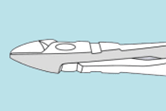


The Shape of the Handles
The objective of each handle design is to optimize the interaction between the tool and the user's hand.Straight Handles
Straight handles are employed when the hand must be positioned at various locations on the handle during a work step. This is frequently the case with concreters' nippers and carpenters' pincers. The all-metal design, which is typical of carpenters' pincers and lacks plastic sleeves, enables the user to slide their hand along the pliers handle as they transition from grasping to twisting, clamping, and ultimately cutting in a single operation.Convex Handles
Convex (arched) handles ensure a precise hand position, which is beneficial for side cutters. Thin plastic coatings created during the immersion process make the pliers non-slip and easy to hold. They protect the hands from coming into contact with naked steel in both cold and warm conditions.Curved Handles
The hand is supported at the front and rear by curved handles. This serves as an advantage whenever substantial force is required. Pliers with multi-component sleeves are more comfortable to use. The contact area between the armrests and the hand is doubled by this design. This substantially mitigates the likelihood of pressure points or scorching. They are advised for frequent use and when substantial manual force is applied.Handle Grips
Handle coatings improve grip comfort while handle covers enhance technical function.VDE Grip
VDE tools are hand tools that are made to be used with electricity. Mostly used by electricians, they keep people from getting electric shocks when they are used correctly. The handles are usually red or yellow and can take up to 1000v.You should not get an electric shock if you work on a live circuit up to 1000v, but that doesn't mean you should use VDE tools for live work. If you can help it, you should never work live. If the insulation on a VDE tool is broken or worn down, the tool should be taken out of service and thrown away in a way that makes it impossible to use again.
ESD Grip
ESD hand tool grips play a crucial role in preventing static electricity buildup, protecting workers and sensitive electronic components from potential damage. They act as a barrier between the user's hand and the tool, effectively dissipating static charges. This protection is vital in industries where even a small electrostatic discharge can lead to equipment failure or product defects. Top-tier ESD grips are built to withstand harsh industrial environments, resist wear and tear from frequent use and often feature chemical resistance, allowing them to maintain their integrity when exposed to common solvents and cleaning agents used in electronics manufacturing.About the Author

Ryan Winters serves as Product Manager at Jameco Electronics, an organization based in the San Francisco Bay Area of California, where he was born and raised. A self-directed learner, Mr. Winters dedicates his personal time to refining practical skills through hands-on work with automobiles, computers, and electronic devices, as well as experimental robotics projects. Through these diverse areas of technical exploration and problem-solving, he further develops the analytical and creative abilities that serve him well in his professional role, where he applies expertise gained from years of independent study and tinkering to benefit Jameco Electronics and their customers.